

For this week’s blog post, I thought it would be fun to include four science facts that I thought were interesting.
Olbers’s Paradox:
Olbers’s paradox was popularized by Heinrich Olbers (though the theory can be traced back to 1601). It highlighted problems with the model of a static and eternal universe before this was proved formally. Essentially, the paradox states that if the universe were static and timeless, there would be an infinite number of stars. The light from these stars also would have had time to travel towards us. Thus, the night sky would appear completely white due to the light from these stars. Since this is not true, the universe cannot be static and timeless.
The Maggot Milkshake:
Entomotoxicology is a branch of forensic science that uses bugs found on deceased bodies to glean information about the cause of death. When forensic scientists find a decaying body, they need to test it for toxins to determine the cause of death. Decaying bodies usually come with a host of maggots eating the body. If the deceased had ingested any drugs prior to death, those drugs will be in the maggots. So, researchers blend them into a “Maggot Milkshake” that they use to test for toxins. This is especially helpful for cases where the body has decomposed to the point where testing becomes difficult.
Finger Muscles:

Did you know that you do not have muscles in your fingers? Instead, finger movement occurs due to muscles in the forearm with finer movements controlled by small muscles in the hand.
Cherenkov Radiation
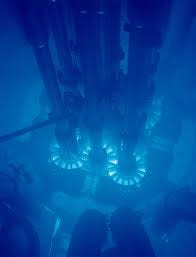
The characteristic blue glow of a nuclear reactor (pictured above) is caused by a phenomenon similar to that of a sonic boom. A sonic boom occurs when an object travels through air faster than the speed of sound. Cherenkov radiation is the same principle, but with light in a medium. In a clear medium such as water, it is possible for particles to move faster than light because in water, light is slowed to only 75% of its original speed. In a nuclear reactor, the charged particles released by the reactor move faster than light. These particles release photons (particles of light). These photons have a high frequency and a short wavelength, so the light appears blue to the naked eye.